Plot holes: six kinds, and not every one is worth fixing
A plot hole is a part of a story that does not fit with the rest. Six kinds, each with an example from a real book, and how to find and fix them in a draft.
Luis Morales14 min read
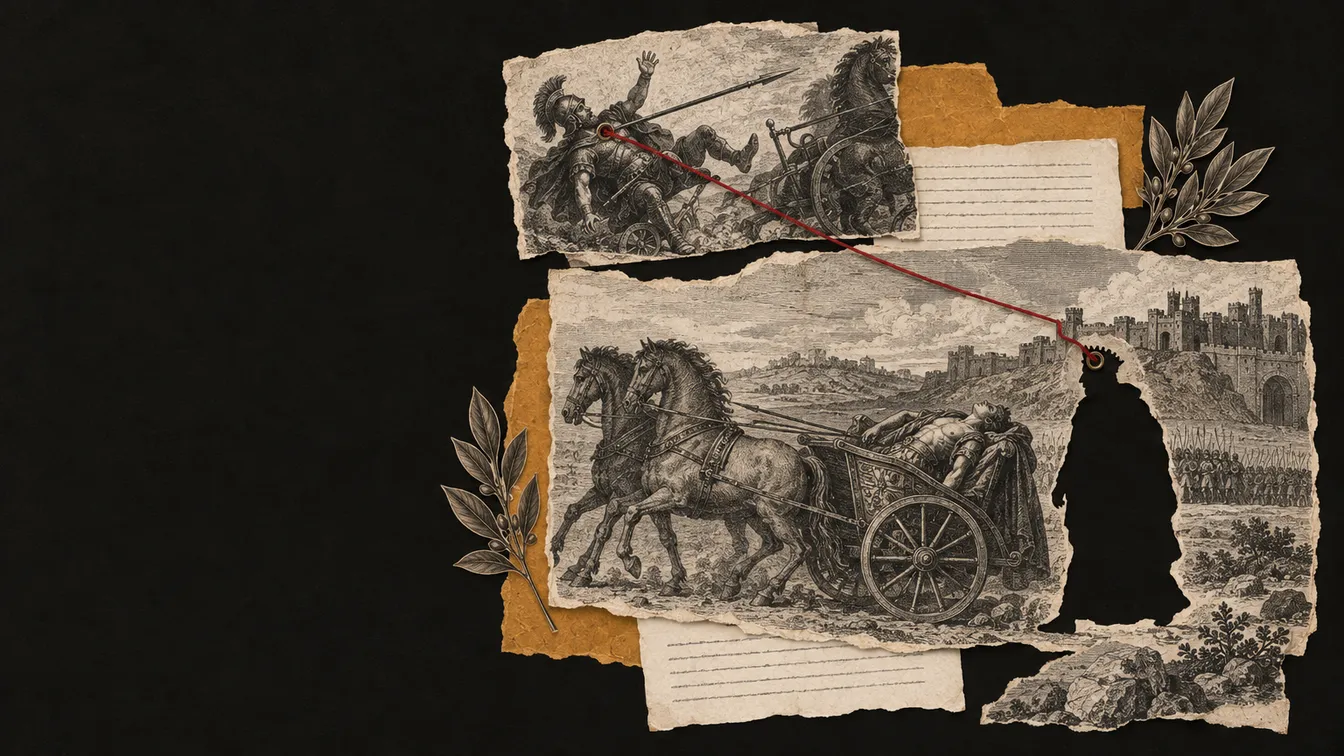
In Book V of the Iliad, Menelaus kills Pylaemenes, leader of the Paphlagonians. In Book XIII, Pylaemenes weeps as he goes with the chariot that carries his dead son Harpalion to Troy. Plot holes are places where one part of a story does not fit another part. This guide gives six kinds of plot hole, one documented example of each from a book you can open and check, and a way to find and fix each kind in a draft.
What is a plot hole?
The Cambridge Dictionary defines a plot hole in one line:
part of the plot (= story) of a film or book that does not fit with other parts of the plot
For a novelist, the working rule is narrower. A plot hole is a place where the book contradicts itself, its own stated rules, or its own chain of causes, and the detail has to matter. A wrong eye colour in chapter 30 is a slip, and a dead man who weeps over his son's body eight books later is a hole. A coincidence is not a hole if the book shows the coincidence happen, and a character's bad choice is not a hole if the page gives the pressure, ignorance or desire behind it.
| Kind | What breaks | Example in this guide | How to find it |
|---|---|---|---|
| Logic | Cause and effect | Six men miss a boat in The Deerslayer (as Twain measures it) | Ask "how?" at every turn of the plot |
| Continuity | A fact the book already set | Pylaemenes dies in Book V and weeps in Book XIII (Iliad) | A fact list per character |
| Timeline | Dates, ages, order of events | Watson has a wife in 1887 (Holmes) | A dated timeline |
| Dropped thread | A promise that is never closed | Sancho's hundred crowns (Don Quixote) | A thread list: opened in, closed in |
| Character motivation | A character acts against what the book says they are | Twain's rule 6 on Natty Bumppo | Ask "why?" at every big choice |
| World rule | A rule the book states | Dracula must be invited in (kept) | A rule list, checked scene by scene |
Six kinds of plot holes, with examples from real books
These plot hole examples come from novels and epics, quoted from the free texts on Project Gutenberg, so you can check every line in the same edition this post used.
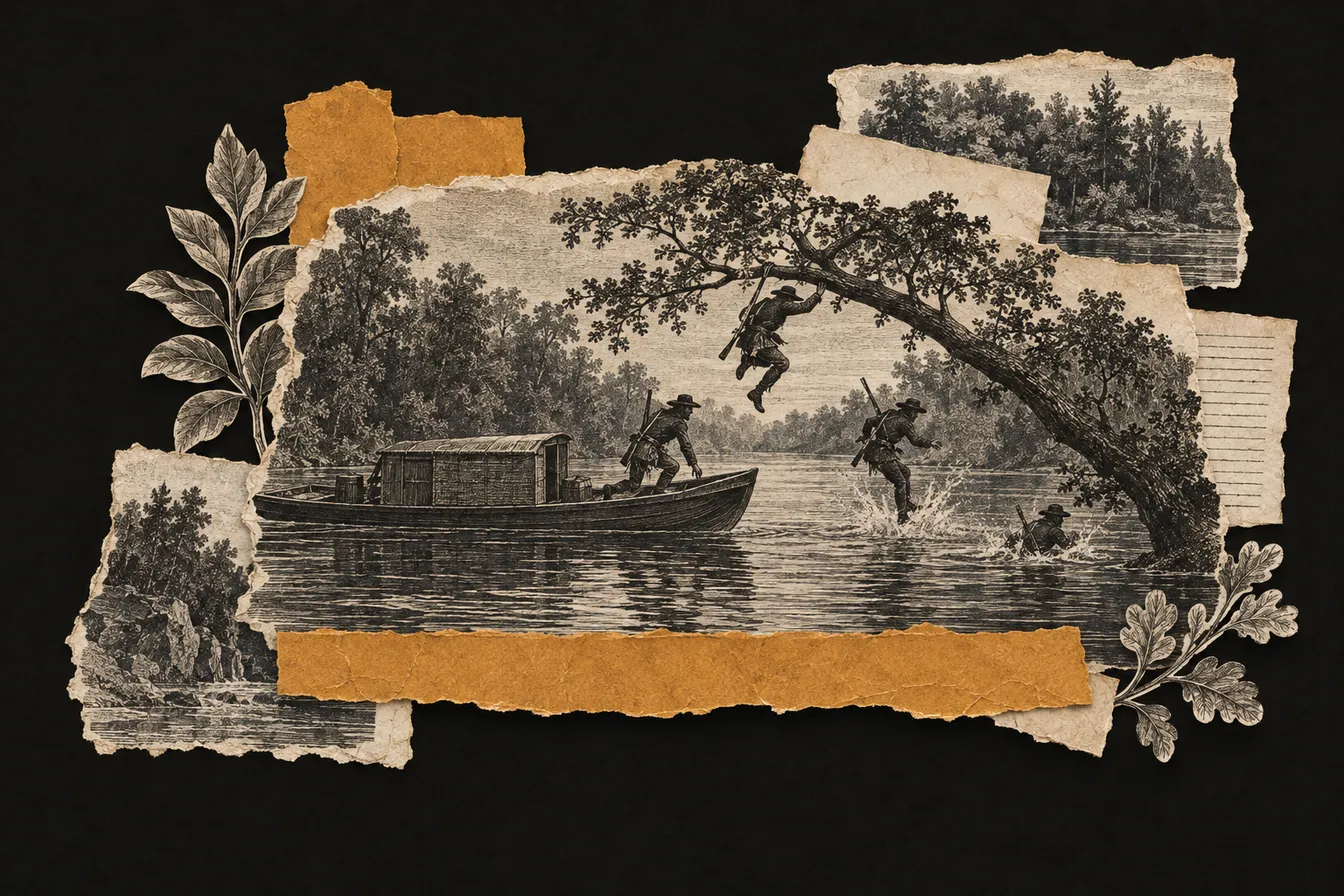
Logic: six men in The Deerslayer
Near the start of his essay "Fenimore Cooper's Literary Offences", published in the North American Review in July 1895, Mark Twain gives a count: "In one place in 'Deerslayer,' and in the restricted space of two-thirds of a page, Cooper has scored 114 offences against literary art out of a possible 115."
The scene he measures has six men hidden in a sapling bent over a narrow stream. They wait to drop, one by one, onto the cabin of a passing ark. Twain guesses the ark at about 140 feet and the cabin at 90 feet, puts the speed at a mile an hour at most, and then does the arithmetic on the page: "It will take the ninety foot dwelling a minute to pass under." The first man drops, misses the cabin and lands in the stern. The other five jump anyway and fall in the water.
Twain's verdict lands on the author: "If the house had been ninety-seven feet long he would have made the trip. The fault was Cooper's, not his." The plot needs the attack to fail, and the scene makes it fail through an impossibility, a cabin too short for the ambush built around it. The reader stops watching six attackers and starts watching a writer moving furniture.
Two concessions. The measurements are Twain's guesses, and the essay is a comic attack. His method still works: take a scene the plot depends on and ask how it works with the distances, speeds and tools the book itself gives.
To find it, ask at every turn of the plot how the event happens with what the characters have and know at that moment. If the answer needs a longer cabin or knowledge a character never received, the turn has a logic hole.
Continuity: a dead king weeps for his son
The Iliad is the oldest example in this guide. In Samuel Butler's translation, Book V is plain about the death:
They killed Pylaemenes peer of Mars, leader of the Paphlagonian warriors. Menelaus struck him on the collar-bone as he was standing on his chariot
Book XIII kills his son Harpalion and is equally plain about who mourns him:
Harpalion son of King Pylaemenes then sprang upon him; he had come to fight at Troy along with his father, but he did not go home again.
[...]
they raised him into his chariot, and bore him sadly off to the city of Troy; his father went also with him weeping bitterly, but there was no ransom that could bring his dead son to life again.
The poem needs a grieving father in Book XIII, and the father it uses died eight books earlier. Why, nobody can prove. The poem came to us with both passages, and any reader can compare them.
To find it, keep one fact list per character (alive or dead, where, with what) and check each new scene against it. A story bible is that list.
Timeline: Dr Watson's wife in 1887
"The Five Orange Pips" opens with a date: "The year '87 furnished us with a long series of cases of greater or less interest, of which I retain the records." The case happens "in the latter days of September", and Watson has a household: "My wife was on a visit to her mother's, and for a few days I was a dweller once more in my old quarters at Baker Street."
Now do the arithmetic against The Sign of the Four. In that novel Watson meets Mary Morstan for the first time. Her father disappeared on 3 December 1878, "nearly ten years ago" by the book's own words, which puts the case in about 1888. In chapter 2 she says: "My mother was dead, and I had no relative in England." At the end of the novel Watson announces the engagement: "Miss Morstan has done me the honour to accept me as a husband in prospective."
So the wife of September 1887 appears about a year before Watson is engaged, and she visits a mother whom Mary Morstan says is dead. Readers can invent a first marriage to close the gap, but the page gives nothing to build it from.
To find it, keep one dated timeline with every date, age, season and "X years ago" in the book. Once "nearly ten years ago" is a year, two years that cannot both be true stop hiding inside the prose.
Dropped thread: Sancho's hundred crowns
In Don Quixote Part I, chapter 23, Sancho finds a valise in the Sierra Morena with a pile of gold crowns in it, and Don Quixote tells him to keep the money. Then the money disappears from the book. Part I came out in 1605.
Cervantes answered inside the fiction. In Part II, chapter 3, printed at the end of 1615, the bachelor Sansón Carrasco reports what readers say:
They say, too, that he forgot to state what Sancho did with those hundred crowns that he found in the valise in the Sierra Morena, as he never alludes to them again, and there are many who would be glad to know what he did with them, or what he spent them on, for it is one of the serious omissions of the work.
In chapter 4 Sancho closes the thread himself: "I spent them for my own good, and my wife's, and my children's." The answer comes ten years late, and one sentence is enough because the thread was small. The donkey is covered in our article on continuity errors in famous novels.
To find it, keep a thread list with two columns, "opened in chapter" and "closed in chapter", and put money, letters, wounds, promises and threats on the list. A row with an empty second column is a dropped thread.
Character motivation: Twain's rule 6
Twain stated the test as his rule 6: "They require that when the author describes the character of a personage in his tale, the conduct and conversation of that personage shall justify said description." Twain names Natty Bumppo as his proof that the rule gets little or no attention in the Deerslayer tale.
A character can act against type whenever the book supplies the cause: fear, money, love, a lie the character believes. The hole is the missing reason. When the conduct contradicts the description and the page gives nothing in between, the reader concludes the plot needed the act and the character was bent to fit it.
Twain's rule 11 goes further: "They require that the characters in a tale shall be so clearly defined that the reader can tell beforehand what each will do in a given emergency." That bans earned surprise, and a novel needs surprise. Rule 6 asks for less: the reason can arrive in the same scene as the act, but it has to arrive.
To find it, list each big decision of each main character and write the reason the page gives for it. An empty reason is the hole.
World rule: Dracula has to be invited
A world rule is a promise the book makes about how its world works, and Dracula states one of its best through Van Helsing in chapter XVIII:
He may not enter anywhere at the first, unless there be some one of the household who bid him to come; though afterwards he can come as he please.
Three chapters later the plot pays the rule instead of breaking it. The Count needs to enter the asylum, so Stoker shows the invitation from inside, in Renfield's own confession: "I found myself opening the sash and saying to Him: 'Come in, Lord and Master!'" The scene exists because the rule does.
The hole would be the same scene with the invitation missing: the Count walks in because the chapter needs him inside, and the promise from chapter XVIII turns out to have been decoration. Readers forgive a strict world, and they notice a world that is strict only when strictness is convenient.
To find it, keep a rule list (magic, technology, law, the physics of the world) with the chapter where each rule is stated, and check every scene that uses or bends a rule against the list. The check is dull, and the alternative is a reader doing it for you in public.
How to find plot holes in your draft
Read for one kind at a time. A general reread finds less, because you read what you meant to write and the page quietly agrees with you.
The five lists from the sections above, gathered in one place:
- A fact list per character: alive or dead, injuries, possessions, relationships, what they know.
- A dated timeline: every date, age, season and "X years ago", resolved to a year wherever the book allows it.
- A thread list: each promise, object, wound and threat, with "opened in chapter" and "closed in chapter".
- A decision list: each big choice by each main character, with the reason the page gives.
- A rule list: every stated rule of the world, with the chapter that states it.
Work through your draft against each list in turn. The manual version of this pass is in our manuscript continuity checklist.
Give the logic and motivation passes to a beta reader who does not know the plan. You fill the missing reasons from memory without noticing. The reader only has the page, and the page is the thing being tested.
How to fix plot holes
Four fixes, each from the examples above:
- Change the earlier page. Plant the cause before the event, or give Pylaemenes a brother who survives him and mourns Harpalion in Book XIII. That is a hypothesis, to show the shape of the fix: the earlier page moves a little so the later page can stand.
- Change the later page. Cut the event or move it. The 1887 wife stops being a hole if the case moves to after the wedding and the wife visits someone other than her mother.
- Put the reader's objection in a character's mouth and answer it. Cervantes gave the hundred crowns complaint to Sansón Carrasco and let Sancho answer it. Conan Doyle did the same in "The Adventure of the Empty House", when Holmes comes back from the dead. Holmes says: "I had no serious difficulty in getting out of it, for the very simple reason that I never was in it." Watson then voices the reader's objection: "But the tracks!" ... "I saw, with my own eyes, that two went down the path and none returned." Holmes answers it in the same scene.
- Leave it, if it sits outside the chain of causes the ending depends on (next section).
Which plot holes are worth fixing?
Not every one. Raymond Chandler could not answer a basic question about his own plot, and said so in a letter to Jamie Hamilton of 21 March 1949:
I remember several years ago when Howard Hawks was making The Big Sleep, the movie, he and Bogart got into an argument as to whether one of the characters was murdered or committed suicide. They sent me a wire... asking me, and dammit I didn't know either. Of course I got hooted at.
The letter does not name the character, and this post will not guess for him. The Big Sleep has a death its author could not explain, and the ending does not turn on the answer. The hole sits beside the road the book travels, and the book travels fine.
The counter-argument is strong. A reader who catches one hole stops trusting the book for a while and starts to check everything else. In a mystery the chain of causes is the contract, and a hole in the solution reads as cheating.
The rule that follows from both sides: fix every hole on the chain of causes your ending depends on, and fix every broken stated rule. Put the rest on a list and decide. A Sancho-sized thread can wait for its one sentence.
What a story bible check catches, and what it misses
Journzy's continuity checker (Author plan) reads each scene against your story bible (Free), which stores characters, places, relationships, aliases and facts that change over time. Each flag shows your line from the manuscript and the bible fact it clashes with, and you fix the line or mark the clash intentional. The author writes every word; the check shows evidence and changes nothing in the text.
That check catches what the bible holds. "Pylaemenes, dead in Book V" is a fact a bible can store, and the check compares each scene with what the bible stores. The plot lanes view in the outline groups scenes by plot in reading order, so you can see where the last scene of each thread falls. The view shows the shape, and you decide if it is a dropped thread or a thread you closed offstage on purpose.
The limit, stated plainly: six men missing a boat is not a fact in a bible, and neither is a missing reason for a choice, so no bible check finds those holes. Logic and motivation live in the relation between scenes, and they need a reader asking how and why.
FAQ
What is a plot hole?
A plot hole is a part of a story that does not fit with other parts of the story: a contradiction with a fact the book set, a stated rule the plot breaks, or a cause the book never gives. A wrong date that nothing depends on is a slip. A dead king who weeps for his son eight books later is a hole.
Is a continuity error a plot hole?
Sometimes. A continuity error is a fact that changes between scenes, and it becomes a plot hole when the plot leans on the fact: when the ending needs the letter to exist or the character to be alive. Eye colour that changes in chapter 30 is an error to correct in proof.
Are plot holes always mistakes?
No. Cervantes turned a dropped thread into a scene ten years later, and Chandler could not explain a death in The Big Sleep, and the book did not need the answer. An author can also plant a contradiction on purpose, with an unreliable narrator or a character lying, and mark it intentional.
How do you fix a plot hole without rewriting the book?
Change the cheaper page. One planted sentence earlier in the book often repairs a hole: a brother for Pylaemenes, a longer cabin for the ark, a case moved to after the wedding. If neither page can move, let a character raise the objection and answer it, as Cervantes and Conan Doyle did.
Every hole in this post fits on a list a few lines long, and the list is the cheap part.
Keep reading
- Character consistency in a novel: keep your cast coherentManual methods, story bibles and software to keep a large cast consistent through a long novel or series without relying on memory alone.
- How to create a story bible: complete guide and templateA complete guide to creating a story bible: what to include, a copyable template with character, place and relationship sheets, and how to keep it alive.
- Continuity errors that made it into famous published novelsCervantes, Defoe, Conan Doyle, Flaubert and Rowling all let continuity slips reach print. What happened, why it happened, and what it teaches novelists today.